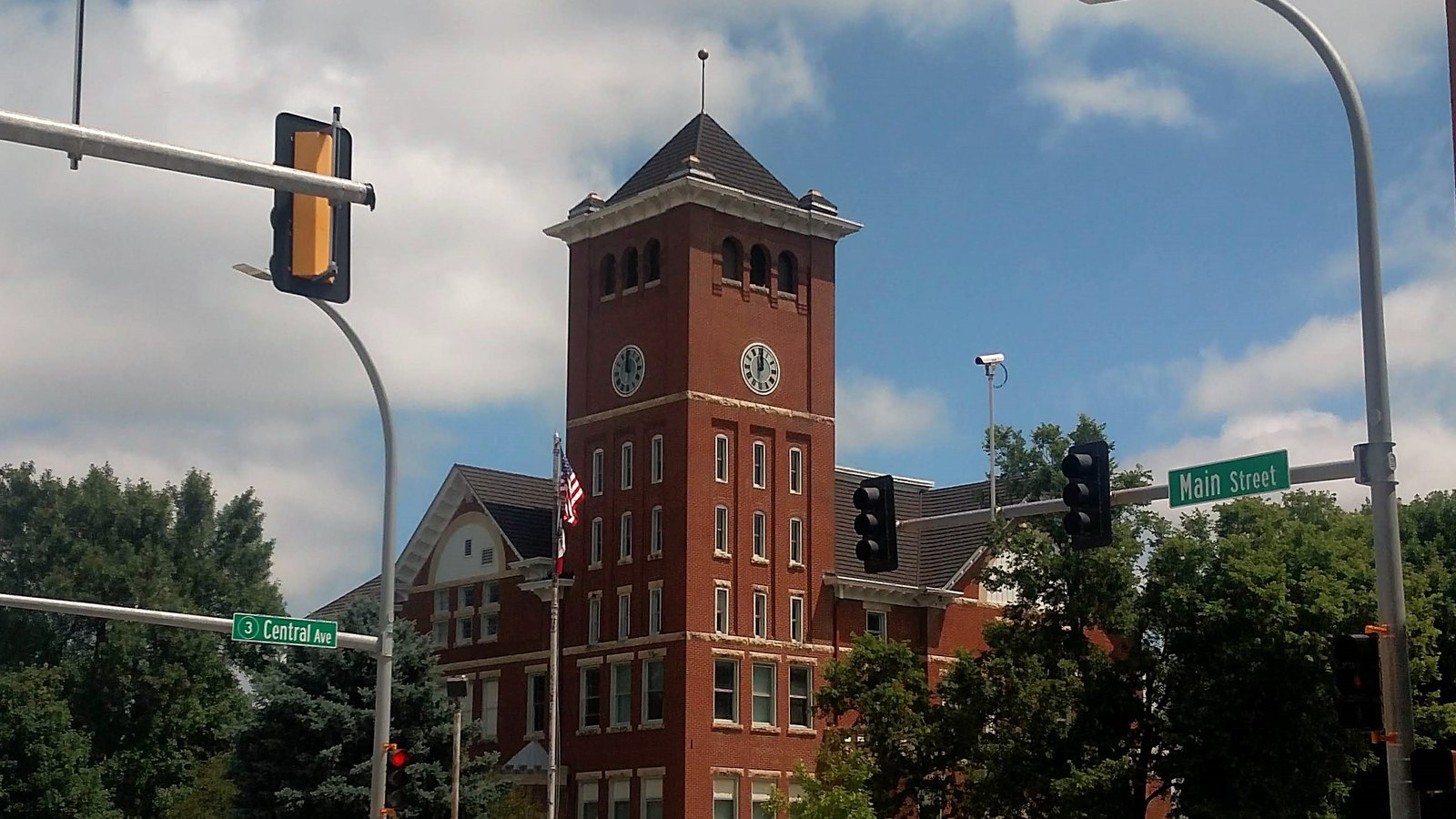

The Wright County Courthouse in Clarion, built in 1891 and 1892. Photo: Brandonrush / Wikimedia Commons, CC0

When the Wright County Board of Supervisors meets Monday morning to take up the Agribusiness Park water rates and the co-op tax refund requests, it will do so in the basement Board Room of a building that went up in 1891 and 1892 for about $50,000.
The red brick courthouse at 115 North Main Street in Clarion is the third building to serve as the seat of Wright County government. The story of the first two, and of how the county seat ended up in Clarion at all, is laid out in the Iowa site inventory prepared in January 1980 for the building’s National Register of Historic Places listing, now held by the National Park Service.
A log cabin, then Liberty
According to the inventory, the first sessions of court in Wright County were held in a privately owned log cabin when the county was organized in August 1855. The cabin stood just west of Eagle Grove.
In April 1858 the county decided its seat of government should be at Liberty. A two-story frame building went up there as the first county-owned building. Liberty did not keep the title long. The inventory says “the heart of county government was moved to Clarion in 1866.” The Liberty courthouse was sold in 1869 and became a general store on the first floor with a residence above. It was torn down in 1913.
The first Clarion courthouse became a hotel
The county’s second courthouse, and the first in Clarion, was another two-story frame building, across the street from the northeast corner of the courthouse square. The inventory says it was built so sturdily that it “showed hardly any signs of wear even 50 years after its construction.” It was later turned into the greater part of the Avondale Hotel.
The 1892 building
The present courthouse was designed by W. R. Parsons and Son and built by E. D. Jones and Co., according to the inventory and the National Park Service’s National Register record. It sits on a base of gray stone, with turrets at the entryways. Most of the building is three stories, and the clock tower rises well above the many-gabled roof.
The 1980 survey called it a vernacular building with “several features which are distinctive among Iowa’s extant courthouses.” It pointed to the very large polygonal projection at the rear and to the front entrance, recessed within a one-story projecting pavilion with a stone roof, a balustrade and a semicircular bay to one side. The surveyor summed up the mix of medieval-style details, bracketed eaves and gable ends as “an eclectic mixture.”
The survey also recorded changes made over the years. Transoms over the first-floor windows and some second-floor windows had been filled in, along with large lunette windows in the gable ends. Inside, it noted dropped ceilings and other modern fittings. The exterior had been sandblasted, and aluminum sash windows and outer doors had been added.
The National Park Service record lists the courthouse under the “County Courthouses in Iowa” thematic group, with architecture as its area of significance and 1891 and 1892 as its significant years.
Why the county seat mattered
The inventory explains what was at stake in those early moves. As the center of county government, it says, an Iowa town “was reasonably assured of economic and population growth, and a prominent role in local social and political life.” A courthouse, it adds, was “a significant public investment in a structure built not simply for utilitarian purposes, but also as a monument.”
That is still true of the building’s daily use. The supervisors’ meetings and the public hearings covered in our News section all run through it. This week’s agenda includes the Agribusiness Park water rate hearing and the co-op tax refund requests that followed the Iowa Supreme Court’s propane tank ruling. Residents interested in the open District 3 supervisor seat can pick up the vacancy notice at the same address.
Wes Bahl writes for Clarion News Online.