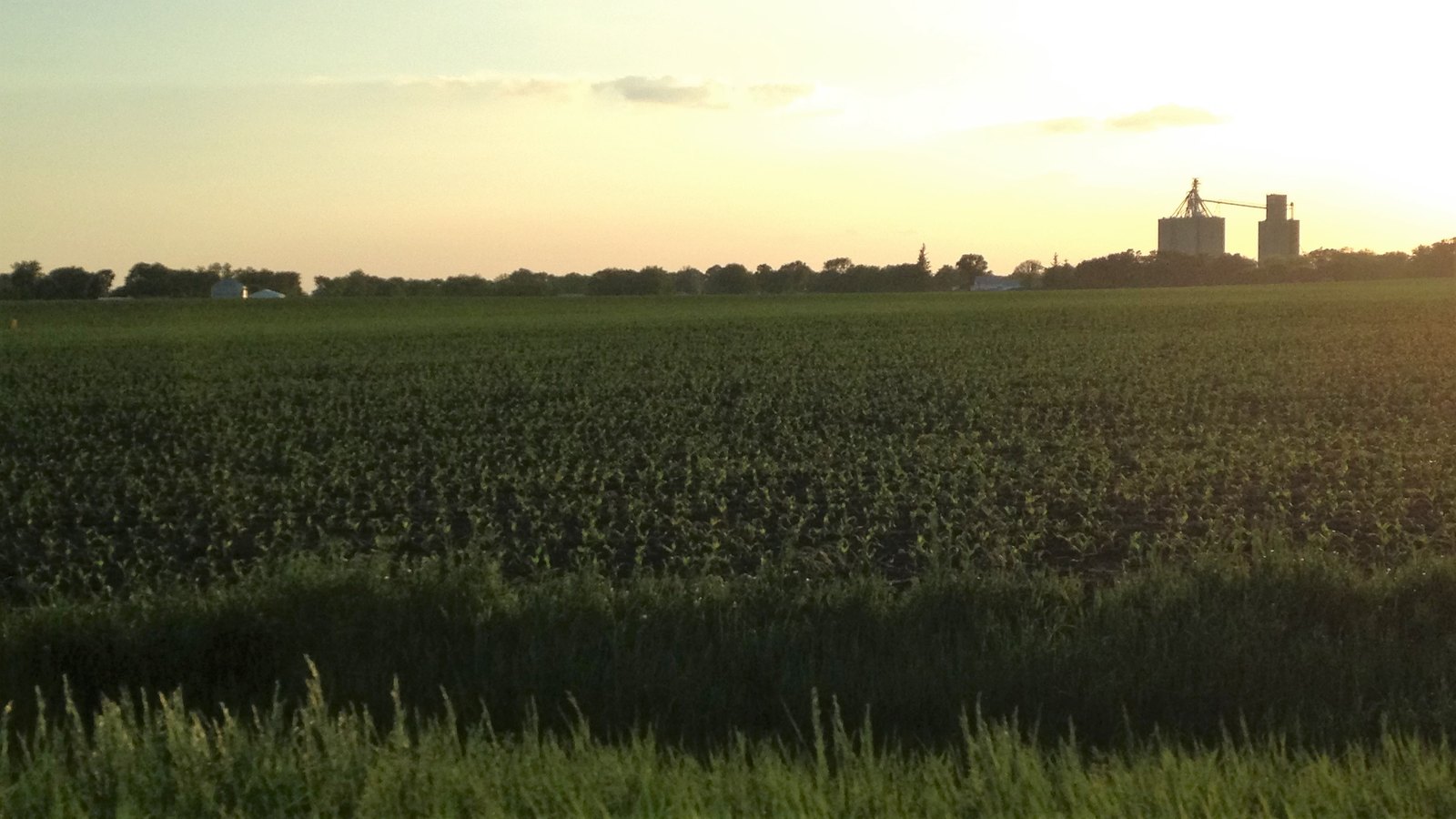

Grain elevators at Somers, Iowa, rise over a field at sunset. Photo: Lacey Niceswanger, CC BY-SA 3.0, via Wikimedia Commons.

One reason Iowa farmland prices have not broken, even after a couple of tight crop years, is that most of the land is not carrying a mortgage.
Rabail Chandio, the Iowa State University Extension economist who helps produce the state’s annual land value survey, told High Plains Journal that 84% of Iowa farmland is debt-free. That lets owners sit tight when income is down, instead of being forced to sell into a soft market. “Lower farm income and pessimistic sentiment have reduced transactions,” she said, and the price changes that have shown up have come on a thinner volume of sales.
She also pushed back on the idea of farmland as a quick trade. “Farmland is not necessarily always going to be a great short-term investment,” Chandio said. “You can’t flip farmland like people flip houses.” Over 20, 30 or 40 years, she said, it has held up as an investment, including in comparisons with the S&P 500, but the return depends on knowing the local ground.
Higher interest rates still work against values, she said, both through what it costs to borrow for a purchase and through higher operating expenses. Those effects can take years to show up in sale prices. Improved crop receipts and government payments this year, in her view, should offset some of that pressure.
Federal payments are part of the story. Seth Meyer, director of the Food and Agricultural Policy Research Institute at the University of Missouri and a former USDA chief economist, told a High Plains Journal conference that large ad hoc assistance finds its way into land bids, especially where operators are renting ground. Outliers such as data centers and renewable energy projects can move prices locally, he said, but they have little effect nationally.
Iowa also limits corporate farmland ownership, Chandio noted, so most buyers are individuals rather than pension funds. The state’s next land value survey is due in December. Until then, the 84% figure is a reminder that a quiet market can be a sign of staying power, not just a lack of interest.
Dale Brekke writes for Clarion News Online.