
Photo: Lynn Betts, USDA Natural Resources Conservation Service / Wikimedia Commons, public domain

Wright County is one of 26 Iowa counties where farmers and landowners can sign up for free nitrogen soil sampling, and Iowa State University agronomists say this is a fall when that information could be worth more than usual.
In a Nov. 16 Integrated Crop Management article, ISU’s Mike Castellano, Daniel Andersen, Sotirios Archontoulis and Mitchell Baum wrote that nitrate levels in Iowa rivers are unusually high this fall. September 2026 was Iowa’s fourth-wettest and ninth-warmest in 154 years of records, and October was the fourth-warmest. Warm, moist soil lets microbes turn organic matter into nitrate quickly, and with corn and soybeans finished for the year, rain carried much of it toward tile lines and streams. On the Raccoon River at Van Meter, the authors wrote, fall nitrate levels are running about twice the long-term average.
Their point for farmers: much of that nitrate likely came from soil organic matter, not fertilizer, since wet fields probably kept fall application below average. That also means some fields may be carrying more nitrogen into next spring than a standard rate assumes.
The free sampling program
The Nitrogen Soil Sampling Project is a three-year pilot run by the Iowa Nutrient Research and Education Council with the Iowa Department of Agriculture and Land Stewardship. Wright County is on the list, along with nearby Hamilton, Hancock, Humboldt, Webster and Kossuth counties, as part of the Greater Des Moines watershed group. Four counties in the Middle Cedar area are also included.
Growers enter basic field information on a sign-up form and agree to a short survey after the season. SoilView does the sampling, Midwest Labs runs the analysis, and the grower gets the field’s residual nitrogen numbers directly. The samples are pooled and anonymized for ISU’s nitrogen and crop models. The council’s page says space is limited to the first 250 fields, and it offers a reminder list for spring sampling.
The ISU authors suggest using those results with the university’s N-FACT rate tool and the late spring nitrate test, which can show whether a field needs less nitrogen than planned. With fertilizer still one of the bigger checks farmers write each year, as bankers have been pointing out, a lower rate on a field that does not need it is money saved.
Waiting on soil temperature
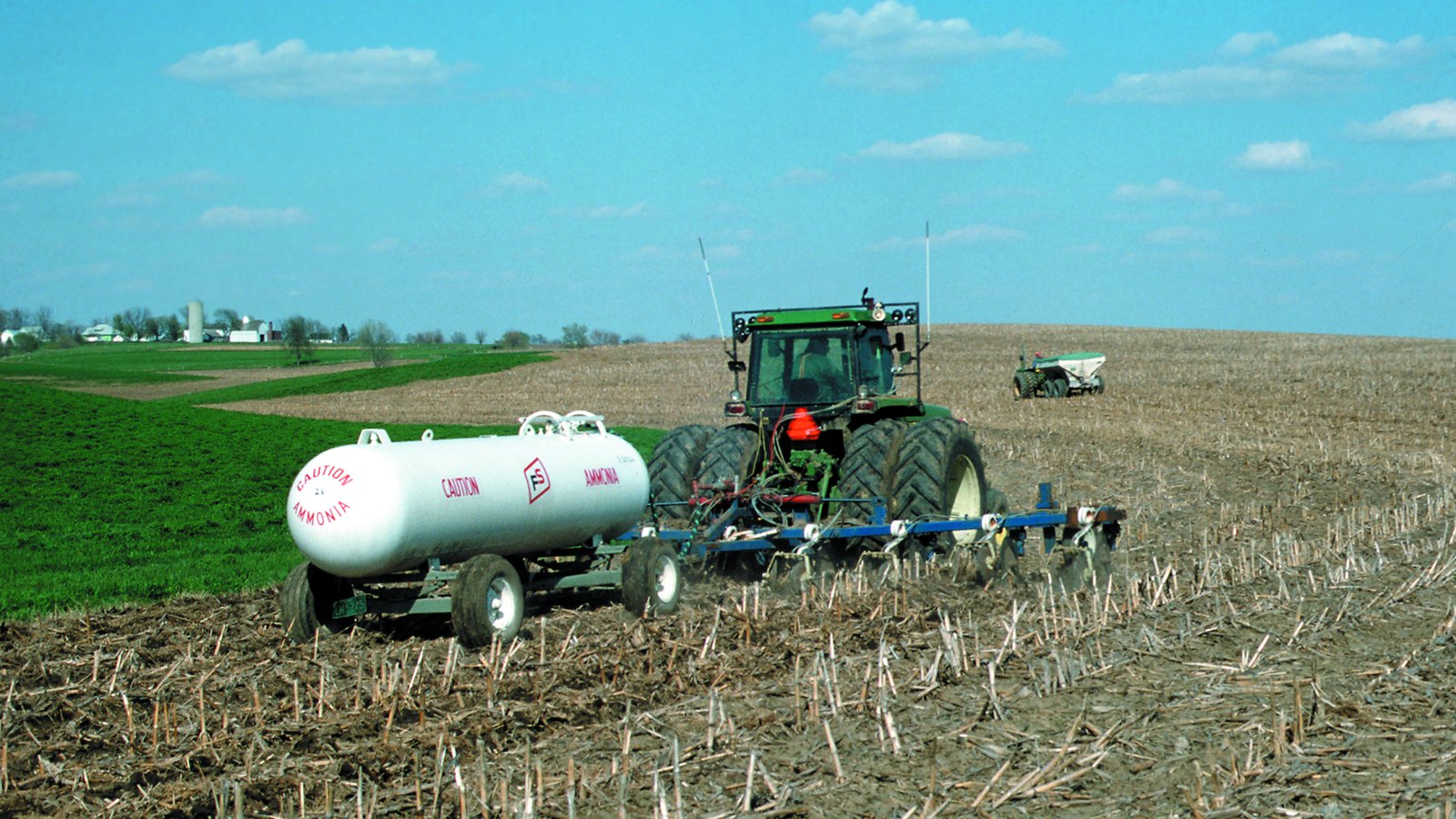
The other advice is timing. Fall-applied fertilizer and manure should wait until soil at 4 inches is below 50 degrees and falling, the ISU article says, because cold soil slows the microbes that turn fertilizer into nitrate. “Applying earlier is a choice to lose nitrogen,” the authors wrote.
Iowa Agriculture Secretary Mike Naig made the same point in the Nov. 15 crop progress report. The first killing freeze ended “one of the longest growing seasons on record,” he said, but 4-inch soil temperatures were still hovering around 50 degrees in parts of the state with warm weather in the forecast. He urged farmers to watch ISU’s Mesonet for when their county reaches “50 and falling.”
That report showed 84% of Iowa’s corn and 96% of its soybeans harvested as of Nov. 15, both behind the five-year average. Fields had 5.9 days suitable for work that week, and topsoil moisture was rated 77% adequate and 21% surplus. The statewide average temperature for the week was 42.6 degrees, 4.2 degrees above normal.
Cover crops and wetlands
The ISU team also pointed to cover crops, which take up nitrate no matter where it came from, and to wetlands that catch it before it reaches rivers. Cover crops are on about 17% of Iowa row-crop acres, and the state has about 147 nitrate-removal wetlands. Meeting Iowa’s nitrate reduction goal would take cover crops on more than half of acres and thousands of wetlands, the authors wrote. For producers who have to empty manure storage before soil cools, they recommend spreading it on a field with a cover crop.
For more on this year’s harvest and what it means for Wright County ground, see our look at USDA’s November yield estimates and the rest of our Farm & Field coverage.
Dale Brekke writes for Clarion News Online.