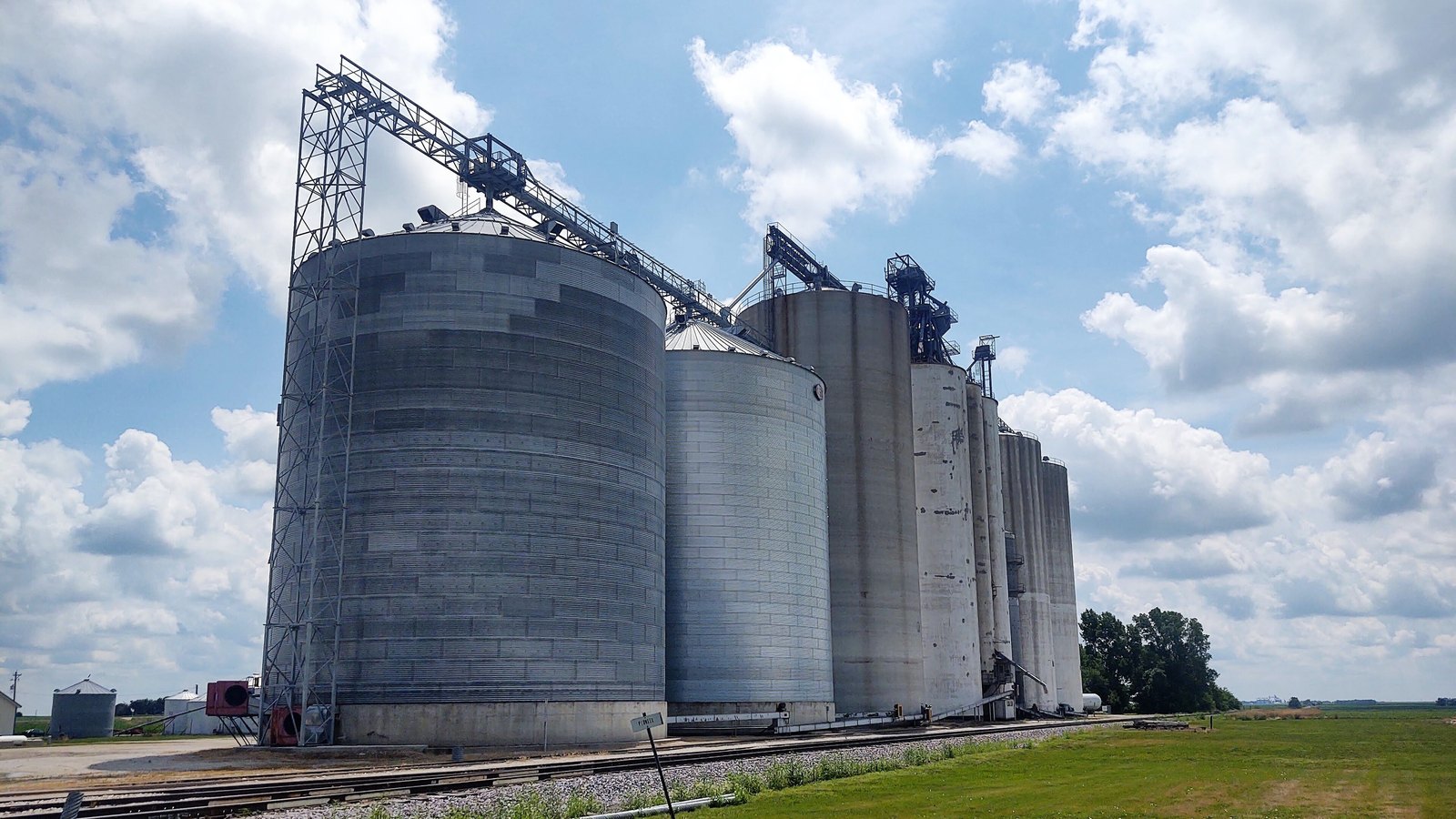

Grain bins at Pioneer, just west of Wright County in north-central Iowa. Photo: Brandonrush, CC0, via Wikimedia Commons.

When Iowa State University’s farmland survey last tallied the state’s values, the softness showed up most clearly in crop country, including the north-central belt that takes in Wright County.
Rabail Chandio, an assistant professor and Extension economist at Iowa State, told High Plains Journal this week that Iowa land values have plateaued after the sharp run-up earlier in the decade. “At the end of 2025, crop-focused central Iowa saw a decline,” she said, “while areas on the eastern and western edges, with more cattle activity, saw small increases.”
That split matters here. Wright County’s economy still runs on corn, soybeans, hogs and the businesses that serve them, not on a large cattle sector. When the row-crop margin tightens, it shows up in what a neighbor will bid at a farm sale and in how a lender looks at the land on a balance sheet. Chandio has also noted that recent value changes have come on fewer transactions, which can make a county average jump around on a handful of sales.
She does not expect a dramatic swing when Iowa State releases its next annual land value survey in December. In 2026, she said, crop margins and farm receipts improved some, and additional government payments helped. Her working forecast is that statewide values move from small declines toward small gains, “below a 5% change in either direction.” A bigger move, she said, would surprise her.
Ernie Goss, who surveys agricultural bankers from Creighton University, offered a similar picture of a slower market that has not come apart. He told the Journal that the era of double-digit annual increases is over, though some sales in northern Iowa and Illinois have still drawn strong money. Farmers, he said, will still look hard at a tract next to their own place, because “it may be 40 years before it will come up for sale again.”
For Wright County families watching the December survey, the useful comparison is not a national headline. It is whether north-central Iowa’s crop ground held, slipped a little more, or finally turned back up after last year’s dip.
Kim Sanders writes for Clarion News Online.