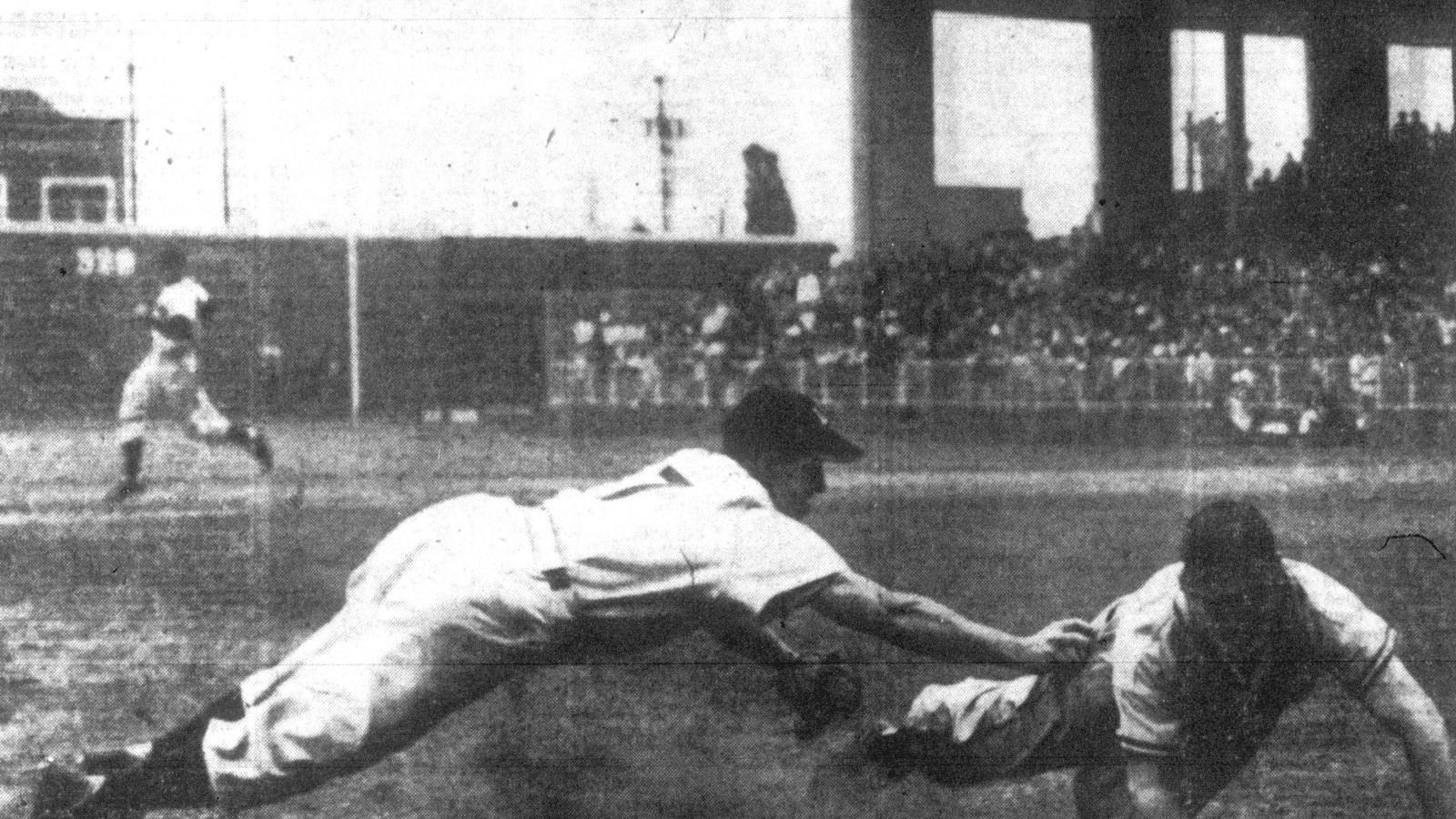

Lee Handley, playing third base for the Los Angeles Angels, tags out San Diego's Steve Mesner on May 15, 1949. Photo: Los Angeles Daily News, public domain

Lee Handley spent a decade as a big-league infielder, most of it at third base for the Pittsburgh Pirates, and he started out on a farm near Clarion. He was born July 13, 1913, to Lee Hupert and Lulu Handley, according to his Society for American Baseball Research biography, and his family moved to St. Louis when he was young. The record books still list Clarion as his birthplace.
His career line on Baseball-Reference reads 968 games over 10 National League seasons between 1936 and 1947, a .269 batting average, 902 hits, 15 home runs and 68 stolen bases. He stood 5-foot-7, weighed 160 pounds and went by the nickname “Jeep.”
From Bradley Tech to the Pirates
Handley’s father died in 1931, and Lee worked in a restaurant and took odd jobs to get through Bradley Tech in Peoria, now Bradley University, SABR’s biography says. He earned 11 varsity letters there and played quarterback, but his size pushed him toward baseball.
The Cincinnati Reds signed him and called him up in 1936. He hit .308 in 24 games before being sent back to Toronto. Then Commissioner Kenesaw Mountain Landis ruled the Reds had mishandled his demotion and declared him a free agent. Eleven teams made offers, and Handley signed with Pittsburgh for $20,000, using $13,000 of the money to buy his widowed mother a seven-room house in Peoria.
He played second base for most of 1937 and moved to third in 1938, when he had his best season: 139 games, 153 hits, 91 runs, 25 doubles and a .268 average. Pittsburgh Press writer Lester Biederman called him “the most spectacular and consistent fielder in the circuit.”
A career interrupted again and again
His SABR biographer wrote that few players had to overcome more adversity, and the injuries started early. In an April 1939 exhibition game in New Orleans, a pitch from Cleveland’s Johnny Allen hit him in the side of the head. He was carried off unconscious and had surgery to remove a blood clot, then was back in the lineup by early May. Whooping cough cost him 30 pounds and 52 games that season, and he still hit .285 and led the National League with 17 stolen bases.
Before the 1942 season he was badly hurt in a car crash west of Peoria, thrown through the canvas roof of a borrowed convertible. The injuries to his right arm and shoulder hurt his throwing, and he spent 1942 and 1943 in the minors with Toronto. That gap shows up plainly in his stat line.
He came back to Pittsburgh for 1944 through 1946, hitting .298 in 1945, and finished in the majors with the Philadelphia Phillies in 1947.
The words to Jackie Robinson
That last season produced the moment Handley is best remembered for. On April 22, 1947, Phillies manager Ben Chapman led a stream of racial abuse at Brooklyn’s Jackie Robinson, who was weeks into breaking baseball’s color line. Handley was not in the lineup that day. According to SABR, he later went to Robinson and told him, “I’m sorry. I want you to know that stuff doesn’t go for me.” Robinson told interviewers in later years that Handley was the first opposing player to wish him well.
Handley’s younger brother Gene, also a Bradley athlete, played for the Philadelphia A’s in 1946 and 1947. Both brothers played their last major league games on the same day, Sept. 28, 1947, and Bradley put them in its athletic hall of fame together in 1949.
After the majors
Handley kept playing in the minors through 1950, including stops with San Diego and the Los Angeles Angels in the Pacific Coast League, where the photo above was taken in 1949. He also worked in radio, hosting a nightly sports show in McKeesport, Pennsylvania, and calling high school games. SABR’s biography notes that his later years included arrests on morals charges in 1957 and 1958. He died of a heart attack in 1970 at 56 and is buried in Coraopolis, Pennsylvania.
Wright County has produced athletes, farmers and business founders whose stories reach well past the county line, from the Hagie family’s farm-born company to the young farmer headed to the Iowa House. The current Cowboys have their own playoff run to remember from this fall. More local lives are in our People & Profiles section.
Greta VanSteen writes for Clarion News Online.